Monday, 9 February 2015

Growth Mindset in my Primary Classroom

Since September, I've been introducing my primary (year 4) class to the idea of how a growth mindset can help with learning.  I'd heard of Carol Dweck before but hadn't done much research into why she was "famous".  In our first INSET days at the start of the year, a colleague used this video (first 10 mins) to introduce the staff team to Growth vs Fixed Mindsets and their power over learning.  If you've no idea what I'm talking about, then I suggest you watch the beginning of that video before you read on! 

Being careful not to just pick up and run with a new fad, I did some reading and watching online to see whether this was something I should be exploring with my class.  Blog posts from secondary bloggers, Shaun and Chris, and the videos embedded convinced me that it was.  I am only 6 months into instilling a Growth Mindset in my classroom so am by no means an expert in this. However, when I started out, I could find no such information to help me make the first steps with my pupils so I hope this can give some guidance for those interested in growth mindset in the primary school. 

Introducing it to the Children
I started off by using two soft-toy characters to introduce the idea of different mindsets to my class.  Year 3 used this previously and found it successful.
"Really Hard" Ratty
"Work-At-It" Wiz
There is no rhyme or reason for it being a rat or a hare - they were simply the only two cuddly toys that I had at the time.  Early on, I told stories about these two characters and their learning - this simply took one 30 minute slot at the beginning of the year.  

Really Hard Ratty has a fixed mindset; he knows that he's good at reading and art but isn't good at maths.  He tries hard in those subjects but thinks he's stupid in maths lessons.  He doesn't try and when he gets stuck he says, "It's really hard."  Work-At-It Wiz (who is sometimes re-named Work-It-Out Wiz) has a growth mindset; he believes that if you put in effort, you can get better at everything.  He tries hard in all subjects, even in subjects that he struggles with.

Using these soft toys - both from Ikea if you're wondering(!) -  immediately gave younger children a starting point for their understanding of mindset.  From the word go, pupils were commenting when someone was "being a Wiz" and recognised the language of the growth mindset.  We discussed changing what we say and watched some videos which showed people being "like Wiz".  

Soon after this introduction, we wrote a short assembly about how we had shown that we had growth mindsets in the first few weeks of term.  Children spoke about and showed learning where they had struggled and put a lot of effort in and made progress.  This was a great way of sharing idea of mindsets with the school and giving the children a voice in their learning. 

Growth Mindset in Planning
Having previously been a self-confessed ability-group obsessive, I was beginning to come around to the idea that mixed tables would enable children to learn better.  I begin to plan not for specific groups but for the highest of expectations from my whole class.  Pupil choice became a big part of my planning and I started using my assessment trays, which had previously been an end-of-lesson resource, as the hub of learning.  I planned an activity which all children would complete and considered how children can be supported to achieve this. You can read more about how I challenge the whole class in mixed-ability groups here.

Growth Mindset in the classroom environment
I've never been a massive fan of lots of quotes on the walls but there are loads to choose from for the Growth Mindset.  This quote about how practice can help progress has become a mantra in my classroom and is the only quote which I have on display permanently. 


The children really took this to heart and so it is used throughout our lessons.  I had a "YOU DID IT!" stamper made so that children knew when their practice had paid off. 


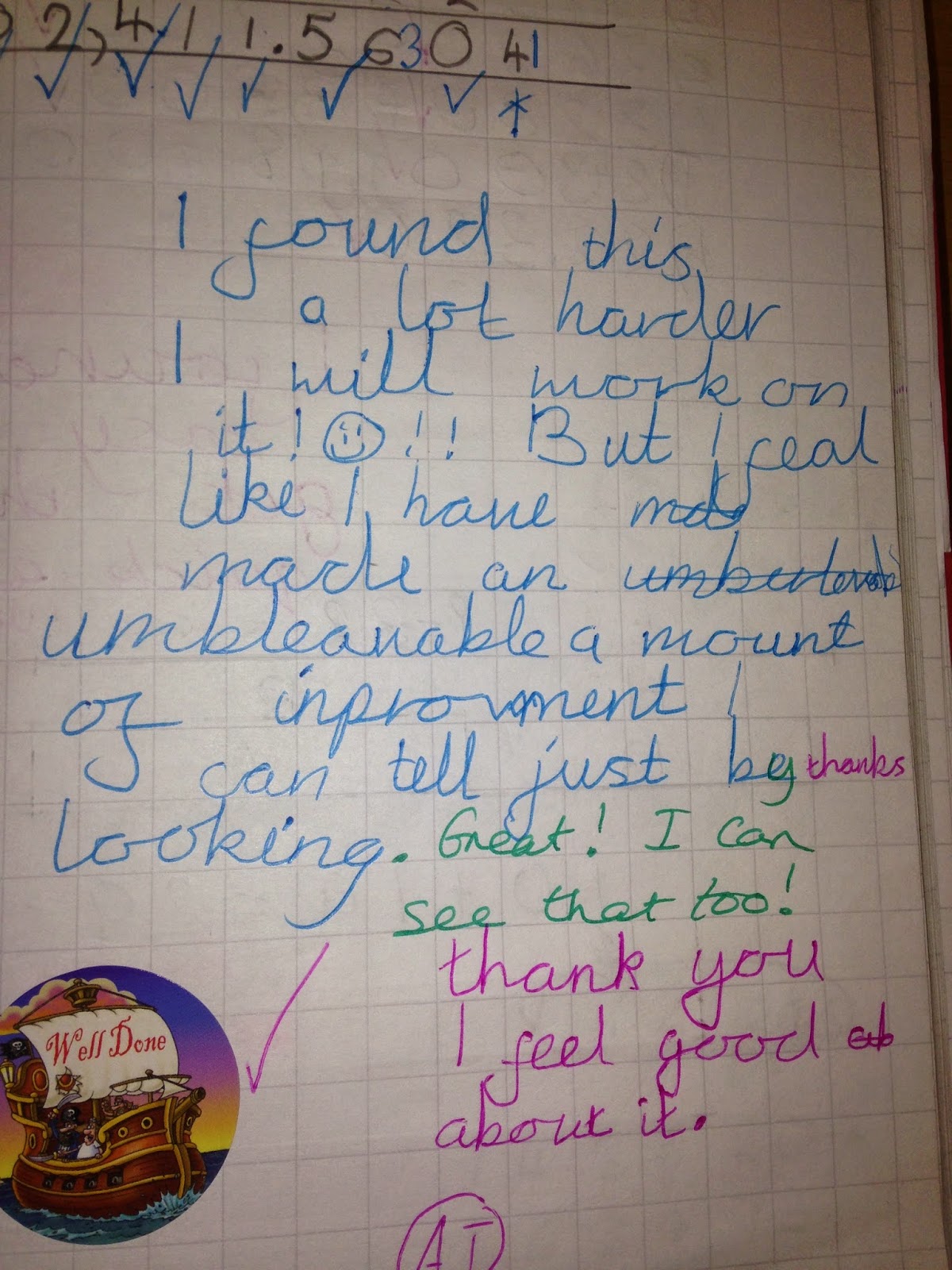
This, in turn, has fed into their own language.  Each lesson, children leave a quick comment about their learning (in gel pen).  Comments like this are not rare:


To encourage a growth mindset, I try and praise children for their attitude and effort, rather than just getting correct answers so you'll see the child above received a house-point simply for being "like Wiz", without necessarily getting lots of questions right. 

Ratty and Wiz are easily accessible in my classroom and children who have showed they are "like Wiz" can sit with him for a lesson.  At primary school, this is such a treat and children's faces light up when they get to have him help them with their work! 

Growth Mindset in Feedback
Learning about the research which has taken place to do with the growth mindset and feedback made me re-consider the comments I leave in children's books.   Carol Dweck encourages teachers to avoid the "clever girl/boy" comments and focus on the skills which children have used and the effort they put in to enable them to learn.  


I had a "Great Learning! Now try this:" stamper made so that children were praised for the progress they had made before being challenged in something new. 


Impact on Attitudes
Obviously, the best thing to do to see the impact this has had would be to talk to my class.  Sadly, you can't do that so instead I'll leave you with some of their post-lesson comments which show their mindsets.  I've never taught a class who enjoy learning so much and so who relish challenging lessons; I'm convinced that's down to the growth mindset elements which have been introduced this year.  


Other Quick Ideas from Twitter
  • Having a Mistake of the Day.
  • Encourage children to add "yet" when they say "I can't do it."
  • Having a crown of mistakes - people who learn from their mistakes can wear it.
  • Enjoying being on the "struggle bus" together.
  • Having display boards which promote a growth mindset.
  • Teaching discrete lessons about the brain and how it works.

Further Information
You can buy the book which started it all off here: Mindset by Carol Dweck.
I'm collecting interesting links, videos and images on my Growth Mindset Pinterest board.
There are many books which can help introduce a Growth Mindset to children in this Amazon wishlist.
The effect of praise on mindset video. 
Mr Bradley's class talking about mindsets video.
Austin's Butterfly video. 

Thursday, 22 January 2015

Using Highlighters in Primary

In recent weeks, there have been a couple of blog posts (from Alex and Jon) about the use of highlighters in school.  Reading these made me think about my use of highlighters so I decided to go on a highlighter hunt in books for how both the children and I use them to have an impact on learning.  I was completely surprised by how much they are used in my classroom so here are some examples of what I've found they can help with.

CHILDREN'S USE
Sentence Structure
I have written previously about how I have tried to help children sort out there sentences.  Below, you can see how the child has serious errors in their sentences.  Using the highlighters to indicate a change of sentence makes it very clear.  The pupil can then re-write the work in the correct structure.  For more information about how I tackle ingrained misconceptions about sentences, please click here.


Maths Word Problems
I know often teachers ask children to highlight the information in work problems.  I get children to highlight the question as many times children have done the working out right but have chosen the wrong piece of information for the answer.  This helps them answer the actual question they are being asked.


Thinking Blocks
The children also use highlighters in their workings out.  As a school, we use thinking blocks to help children visualise mathematics.  Sometimes, it is necessary to colour some blocks so using highlighters is much quicker than colouring in or shading.  The child below is finding fractions of a number so she has used highlighter to indicate the amount which showing her understanding of the maths concept.


Here you can see highlighters used in fraction word problems and the calculation of the answers.


Long, Chunking, Bus-Stop, Column Division Method (Or whatever else you want to call it!)
Here, highlighters help the children locate where the answer is in their working-out notes.  


Subordinating Conjunctions
When using subordinating conjunctions at the beginning of sentences, children often forget the comma.  I can't remember whether this highlighting was done by a peer or the children themselves but it has helped to highlight the important parts of the sentence: conjunction at the beginning, comma after the clause and ending punctuation.  This serves two main purposes; it helps the children do corrections if they have missed elements and it highlights the key learning so it's easier for me to mark.  


ADULT'S USE
Stampers
I have a few stampers which give different options - highlighters make it clear which part refers to the work.  Our success criteria is organised into Good/Amazing/Awesome and I have a stamp to indicate that a child needs to remember Capital Letters or Full Stops.  You can see these highlighted below. 


Addressing Misconceptions
For children who can read and understand my comments, highlighters help me in explanations of their misconceptions.  Below, I have written out the calculation and the highlighter has helped me focus her attention on her target.


Pink/Green
Many primary schools use this: Pink = Tickled Pink = Evidence of great work  Green = Growth = Things to improve.  As you can see from the photos below, I use this across their work and on our success criteria which is titled Good / Amazing / Awesome (inspired by Ian).  Sometimes I provide corrections for the green areas but often it is the child's job to correct their work.  A simple pink or green mark near the end is accompanied by a comment to show an overall assessment of their work.


Monday, 19 January 2015

Scribble HQ - Writing Working Wall Display

Inspired by FootieFanMiss' Working Walls, this year I have kept a writing display as a fluid way of recording what we are learning and to help children improve their writing.  This is definitely a work-in-progress but the kids are really enjoying using it at the moment and it is having more impact than many of my displays have before!  This short, photo-heavy post will be a quick tour of what's on there and why!  To start with, this photo shows the wall as a whole.  I've called it "Scribble HQ" after the the location in my favourite children's book, Scribbleboy by Phillip Ridley.  I tend to read part or all of this book to every class so they understand the link! 
We are really focusing, in year 4, on word types so we have some mini word - clouds.  Some of them are pre-made but most are the children's ideas, sometimes with names or initials to give them ownership of the words.  
There is a space for our Alan Peat sentence of the week.
Next to this are some examples of the Alan Peat sentences in the books we have read as a class.  The children have got really good about pointing these out as we're reading so I try and bookmark them and write them up! 

When children bring in work which they've done at home linked to our writing, that goes on Scribble HQ too. 
I can use the display to address any little misconceptions which are consistent across the class.  Here you can see they are struggling to differentiate between these two words so this should remind them, complete with my lovely stick men! 
These post-it notes have been added this week because we are working on inverted commas for speech.  I stole some words instead of "said" from children's work, wrote it on a speech bubble and put their initial on it.  We'll add to these over the next few weeks so that children can have a variety to choose from. 
As I said, this is just a start and something I'm experimenting with this year.  I was a bit hesitant at first as I was unsure that it would be used by the kids and was worried it would take forever to do.  However I've found most of the content can be added in lessons and the kids use it all the time! 

UPDATE July 2015:
This is how the Scribble HQ display looks at the end of the year (minus my finger  and stapler - sorry!).  There are a few additions that are probably quite unclear:
th (top left) - lots of my class use f or v instead of sticking their tongue out for th. Cue a quick doodle to model it correctly. 
cos > because (at the bottom left) - I'm trying to counteract this lazy speech.
Tricky Spellings (top in the middle) - I just keep adding to this when particularly hard spellings crop up. 
TiP ToP paragraphs (top right) - just a quick reminder. 
Prefixes and suffixes (top left) - trying to make this part of their everyday language. 


Wednesday, 31 December 2014

Fall Back to Spring Forward #Nurture1415

Last year, I got so much out of writing my #Nurture1314 blog post so I am here once again to reflect on the year that has passed and look forward to what may come! 

Falling Back - 2014 in review

  1. New York City - Without a doubt, this was the highlight of my year.  My husband and I talk about it every day without fail and are planning to return as soon as we can afford it.  I wrote a quick top 10 list about what we did (including photos) here. 
  2. Year Leader - When I wrote this on my 13/14 list last year I had no idea that the opportunity would arise so quickly.  With the incredibly sad departure of two superb year leaders to "up north", I was very grateful to be given the opportunity to take one of the roles.  It's felt like a baptism by fire but it was exactly the challenge I was after for my 4th year in teaching.  
  3. NQT - Last year, I was in the middle of supporting my husband through one of the hardest NQT years I've heard of.  Sadly, it just got harder for him but eventually he passed and is now a fully fledged, fully-qualified member of the profession! I'm so proud of him and am amazed at how he's pulled through.  He's survived 2 OfSTED inspections in his NQT year - not many people can say that!
  4. Blogging (School) - I have almost got my school onto the blogging wagon, with them now using a Writers Blog which I set up.
  5. Blogging (This one!) - Having stuck to the only-post-when-there-is-something-worth-saying mantra here, my posts are few and far between but I've enjoyed writing them and the feedback from people who use some of the ideas makes it worth it.  This year people have been interested in improving their marking and feedback and have had lots of questions about whole-class reading lessons.
  6. The Hardest Term - For many reasons, this last Autumn term has been the hardest of my teaching career so far.  I feel like surviving it with a smile has been a real achievement.  Hopefully the worst is over and I can enjoy the rest of the school year. 
  7. Writing - Through Twitter and this blog, many exciting opportunities to write for other organisations has arisen.  I've most enjoyed writing a couple of articles for Teach Primary magazine and reading fellow teachers' ideas in it.
  8. Reading - As always, I haven't read as much as I would have liked but I've still managed to read some crackers.  My three best author discoveries this year were M.J. Arlidge, Peter James and Harlen Coben, all of whom write in the crime/thriller genre.
  9. Theatre - I've seen a good bunch of shows this year including Jersey Boys, Billy Elliot and taking 17 people to see Wicked.  My theatre highlights of the year were seeing Kerry Ellis live in Horsham and the Pheasantry (London).  
  10. Reviewing - This year, I've re-started reviewing theatre for The Public Reviews.  As part of that, I've had the chance to see The Mousetrap, the Illegal Eagles and the Wicked UK tour for free (click the titles to read my reviews).
  11. Friends and Family - We've had the chance to head around the country this year to see various family members and friends.
  12. Having Students - I feel like mentoring is a rite of passage into leadership in schools.  It gave me a lot of skills and understanding ready for my year leader position and I hope to continue supporting students each year.
  13. Netball - This year, I've joined a team and absolutely loved playing every week.  Having never really been sporty before, I'm not competitive at all but completely enjoy the team spirit and exercise.  
  14. Trips and Gigs - Harry Potter Studios, McBusted and Taylor Swift have provided memorable trips out with treasured friends throughout the year! 
Springing Forward - Hopes for 2015
  1. Job Adventure - This year will start with my husband doing supply to find a settled role.  
  2. Moving House - Maybe this year....maybe not! 
  3. Blogging (at school) - I hope that the school will continue to enjoy blogging and that parents will see the benefit of commenting and interacting.  Our purpose is to enhance the place of writing so I hope that will be a side effect once blogging takes off. 
  4. Blogging (this one) - If I've got something to say, I'll continue to say it and maybe people will keep reading.
  5. Reading - I'm going to try to get through the Peter James series this year and maybe see one of his books as a play.
  6. Writing - If the opportunity arises this year to write articles or posts for publications or websites, I hope to be in a position to say "yes".  
  7. Theatre Reviewing - I'm hoping to do lots more of this in 2015, workload dependent of course.
  8. Double Family Holiday - this year we're going abroad with the in laws and the parents! We'll see how that goes but I'm looking forward to both.
  9. Wedding - not mine but my sisters! 
  10. Wycombe Wanderers - We scraped through to stay in league 2 last year...perhaps we could be promoted this year! I hope to see them play more in 2015 - maybe that will help!
  11. TeachMeet Sussex - Over 150 people have come to this event in 2014 - perhaps 2015 will be a bigger year.
  12. Saving Money - we're not very good at putting money aside each month so maybe this will be the year we crack this.
  13. Friends and Family - I hope this year will be full of more exciting trips around the country.
  14. General Election - Despite always voting, I've never really been interested in politics but this year I'll be keeping a close eye on what happens.
  15. Work/Life Balance - I said it would be here every year until retirement so...here it is. I may be proved wrong, of course, if Nicky Morgan can sort it out!

Sunday, 14 December 2014

Making Marking Speedy

I've previously written about how I use gel pens to Make Marking Meaningful, however I've tried a lot of strategies since my NQT year to enhance the speed of my marking.  Here are some of the ideas I've tried which work.  As with everything else in teaching, these are used when appropriate in a range of subjects! 

Answers
Note: particularly useful in maths or SPAG activities.
On the outside, this is very simple: have some form of answers available so the children can mark the work.  However, how the answers are used can affect the degree of learning taking place.  For example, sometimes children mark their own work at the end of a lesson.  They have time to complete any corrections in gel pen (read why here) and comment on their progress.  Alternatively, they check their answers halfway through the lesson to assess whether they are on track.  They then choose to continue working to become confident, move onto something more challenging or get some help to address their errors.  This ensures that all children are challenged at their own level.  Of course, children can mark each other's work and find errors that someone else has made. Sometimes I make the answers available to children throughout the lessons so they can check any one answer and get immediate feedback.  They find this really useful because they can get help straight away if it is incorrect and an adult or child can talk through the process when it is fresh in their mind.  This means any post-lesson marking can be focused on misconceptions and next steps as all corrections will have been made in the lesson.  

Peer Editing
Note: great for long pieces of writing in any subject.
I discovered this after reading through 31 fairly poor pieces of writing and despairing at the length of time it would take me to mark them.  Having looked through but not marked the work, I went back to my class and explained to them that I had chosen not to mark it because there were so many mistakes.  I felt so harsh but by the end of the next hour I knew I'd done the right thing.  Knowing their two main mistakes - tense and viewpoint (first/third person) - I'd prepared a piece of writing filled with those two errors to be the input of my next lesson.  As a class we read it through, the children realised that it sounded wrong and they corrected the errors.  Then, in pairs, they completed two activities.  Firstly, with no pens in sight, they simply read their partners work aloud back to them, word-for-word.  Both children did this as it was important to hear and realise that their errors were fairly similar early on.  Next, they edited for the mistakes, corrected spellings and improved words and phrases if they had time.  The quality of work I had back in was substantially higher than it had been and it meant my marking time was cut by over 50%.  At the end of the editing process, I asked the children to comment on how they found it.  It was clear from what they wrote that they had got a lot out of it and wanted to do it more often.  Therefore I've added a similar lesson during most long pieces of writing.  

Hold A Pen
Note: Useful in any lesson! 
Make sure you, your TA and any other adults are armed with a pen during the lesson.  Give the instruction that if they work with a child, they should quickly mark their work to get an idea of how they can help.  As a teacher, this means as you verbally check work you can leave a mark to show this and any workings done with you stand out.  This makes tracking progress easier as independent or adult-assisted work is obvious.  I've found children like having their work marked during the lesson if there's time and it's a wonderful feeling to open the next book in the massive pile and find it already marked! 

Stampers
Note: This costs a bit at first (£5-10 each) but saves so much time in the long run and they last ages!
I have written at length about why I use stampers and which ones are most effective.  Quite simply, they are the one strategy which has had the biggest impact on reducing the time I spend marking.  I cannot recommend them highly enough and I'd encourage anyone aiming to reclaim some of their work-life balance to invest in a few effective ones.  

Underlining
Note: Particularly useful in grammar activities and English lessons.
As part of the plenary in certain lessons, I ask children to underline in gel pen the main elements of the learning.  For example, if they have be learning to use subordinating conjunctions, then I ask them to underline the ones they have used.  That way I can see if they have used the correct conjunctions with commas if necessary and check whether the words they have used make sense in their sentences.  This sometimes highlights to children they they haven't used any or many and gives them a chance to correct this before the work is marked.  When I come to mark the work, the coloured lines guide my eyes to where I need to look to assess the extent to which children have achieved the learning objective.

Favourites
Similar to underlining, I sometimes ask children to put a *star* by their favourite sentence, fact, calculation, word problem etc as is appropriate to the lesson.  I explain that I will look at all their work but will mark their favourite in detail.  Likewise, I sometimes ask children to circle any which they have struggled with or which they think are incorrect so I can look closely to help them with those.  Again, my eyes are drawn to the symbols used so that my marking can be completed quicker. 

Codes
Note: Useful for presentation errors.
Thankfully we don't have a whole-school marking code which I have to stick to religiously.  I'm not a big fan of long marking codes as children can spend longer deciphering the marking than actually learning from it.  That being said, I do use codes to improve children's presentation; mainly 4 symbols.  T indicates they need to write the title (as required by the school - only 1 or 2 words).  D shows they should write the date. U implies they should underline the title or date and I draw a simple tree if they are wasting too much paper (save the trees!).  These 4 codes take hardly any time to draw, save me writing sentences and ensure the children can understand and respond quickly to presentation errors.  

Primary Roll Call - Classroom Ideas

As part of a joint venture with Michael Tidd, I am collating some of the primary tweeters, bloggers and pinners who share exceptional practical ideas for the classroom.  This collection of educators, through their tweets, blogs and Pinterest boards, have had a direct impact on my teaching; their ideas are sound and they are certainly worth a "follow".

So, here goes, as Dermot says, "in no particular order":

Claire (OhLottie)
As the inventor of Graffiti Maths and an all-round inspirational primary teacher, Claire's ideas are always tried and tested and come with her own evaluation on their use.
She tweets, blogs and pins.

Sam (SAiston)
Sam provides a no-nonsense commentary on Education with lesson ideas and common sense theories for the primary classroom.
He tweets.

Rob (RedgieRob)
Famous for being the creator of The Literacy Shed, Rob also (somehow) manages to simultaneously be a fantastic primary teacher.  His twitter feed is full of good practice and useful resources.
He tweets.

Alison (AliMattWells)
This lady is a fount of practical classroom ideas; whether displays, English, maths, topic - she's got it covered!
She tweets.

Michelle (FootieFanMiss)
With extensive Pinterest boards covering a range of education themes, Michelle is well-worth following.  She is an advocate of Working Walls and has some brilliant examples on her blog and Pinterest boards.
She tweets, blogs and pins.

Ian (IanAddison)
As a former ICT advisor for Hampshire, Ian's posts about technology are really useful.  However, since moving back to the classroom, he provides useful ideas and resources to be used throughout primary lessons.
He tweets, blogs and pins.

Rachel (rpd1972)
Rachel's blog posts, tweets and articles focus on simple ideas which have made a difference in her primary classes.
She tweets and blogs.

Sarah (Sarah__wright1)
In the important job of training primary teachers, Sarah shares brilliant ideas for KS1 and 2 classrooms along with inspirational books and quotes from the training programme at Edge Hill University.
She tweets and pins.

Sway (SwayGrantham)
Sway is an important UK educator to follow if you are interested in the changes being made to technology in learning.  She has some specific advice relevant to BYOD and Rasperry Pi in primary education.
She tweets and blogs.

Lisa (TishlyLishly)
As Early Years queen, Lisa regularly shares early reading and maths ideas, impressive display photos and ways to enhance themed areas.
She tweets and pins.

BONUS - There are a few secondary bloggers, tweeters and pinners who give superb ideas which are easily transferable to the primary classroom.  However, Rachel Jones' fount of inspirational blog posts, tweets and pins stands out from the rest so I feel she deserves to be an honourary primary teacher for the sake of this list!

Michael has published a similar list of Primary leaders and thinkers here.  You can follow him on Twitter or his blog.  I collect and share ideas on Twitter, Pinterest and this blog.

Tuesday, 25 November 2014

When Will I Get My Oscar?

You may think that I'm a teacher,
And that goes some way to say,
A little about the activities,
I complete in school each day.
You may think that I'm an expert,
And it might surprise you so,
That, really, I'm just an actor,
Who's a little in-the-know.

I crammed in the information,
The night before the class,
Put on a special wig and clothes,
And answered the questions you asked.
You played along, like I was somebody else,
A famous historical doctor.
It was such a great performance so,
When will I get my Oscar?

You really hurt me yesterday,
Using names so rude and mean,
And today I'm meant to treat you like,
It's forgotten; the slate is clean.
I smile and greet you as each day,
In my mind is yesterday's phrase.
You're completely none-the-wiser so,
Will my Oscar arrive in a few days?

I tell you stories using my face and hands,
Creating characters with my voice,
You complain when others 'don't do it right',
And, when I'm done, you all rejoice.
Each lesson; an elaborate episode,
I've learned the script by heart.
My audience are hooked to know the rest,
Surely an "award-winning" start?

There are times when you are struggling,
Disrupting and causing a scene.
I know you are craving attention,
Sometimes angry or overly-keen.
The learning continues, as that is my job,
'The show must go on,' I know.
It takes all of my talent to ignore you,
You stop. It worked. What a show!

In life, the worst news possible,
So much pain within.
But my audience expect the usual cast,
So I get up and drag myself in.
Inside, I'm cut up in pieces,
There's nothing that anyone could say,
But I'm on stage so I 'act naturally',
Is my Oscar on its way?

The directors want me to change the script,
The props - the whole production.
Really, I know my audience best,
I keep going with minimum disruption.
They want to review my performance,
So I simply adjust the show.
"When will I get my Oscar?" I cry,
Doesn't anybody know?

Each day the red curtain rises,
The education stage is set.
How much we both put into this,
Will affect how far you get.
The truth is: I won't get an Oscar,
And that's certainly not what I need.
The fact that you love learning and school,
Is like a standing ovation to me.