Sunday, 26 April 2015

Dear NQT Mentors...

I've heard most of you are amazing.  Like my own NQT mentor, you inspire, encourage, support and advise.  You invite new teachers to watch you teach and give them guidance with planning, assessment and classroom management.  Respectfully, you give achievable targets after observations before planning in strategies for ensuring they are met.  You recognise that rest is as important as hard work in surviving as a teacher and encourage it to improve well-being.  Those in your care look up to you because they can see you looking at them with huge potential.  

However, there are some of you who are letting the team down.  Among my network of friends and colleagues around the country, I have heard time and time again of NQTs having a really rough ride.  My first instinct is that they're simply in a tough school or that they are poor teachers but, after delving deeper, I discover this isn't the main problem.  The common factor among these horror stories is a mentor with no clue as to what the role requires and how to provide effective support. 

Apparently you expect them to know it all already.  You get frustrated when having to explain something that they 'should have learned in training'. Well what if they didn't? What if they never came across that or their university didn't include it as part of the course or, God forbid, they missed that day due to illness?  It seems you take no excuses, however justified, and your lack of want to help them this time only prevents them from asking again. 

Some of you are obsessed with grades; both for teachers and children.  You see yourselves as a judge when it comes to regular lesson observations rather than a fellow professional.  I've heard that some of you struggle to stick to one or two points for development, preferring a couple of positives before a seemingly endless list of improvements. These NQTs are a far cry from the children we teach but it's two stars and one wish in that ratio for a reason.  I'd encourage you to try observing the lessons using just positives and one improvement; It sounds like you might struggle. 

I imagine that you've been teaching a while so you're in a good position to tell whether someone's lesson is up-to-scratch.  It sounds like you've judged some of my friends as being less-than-satisfactory or worse, inadequate.  Sometimes, perhaps, this was justified.  My issues lies with what you did next and it's the same story around the country: you observed more.  Multiple observations in the space of a ridiculously short period of time. Unannounced drop-ins and minimum feedback. Ever heard the metaphor about weighing the pig?!  It's completely unacceptable and unhelpful for the NQT.

My heart breaks for the energetic, inspired and creative lady or man who ends up in your 'care'.  In my experience, they end up forced out of your school before their probationary year is up in the fear that you'll fail them, leaving them unable to teach again.  Those who survive, get to the end of the year with their flare for teaching extinguished, using phrases like, "only the kids got me through" when they should be praising you for supporting them to succeed.  

Thankfully, the good among you massively outnumber the bad but I simply cannot ignore these stories any longer because I'm all too aware that it could have been me.  I also wonder, when the statistics are mentioned, just how often poor mentors or lack of support are cited as the reason so many leave teaching in the first 5 years.  I certainly know a few who would.  

So to those mentors continuing to support, encourage and inspire the next generation of teachers; please keep doing what you're doing.  You're making a massive difference and ensuring there are effective practitioners coming through to be leaders.  To colleagues who know that there are struggling NQTs in your school; please encourage them and keep an eye out for them, questioning anything you feel is inappropriate.  To those who are causing these problems; you're probably not reading this anyway.

Mrs P

Final note for NQTs: If you find yourself in a very difficult situation, please find yourself a support network whether among colleagues, non-teaching friends, family or though Twitter.  Use your union and let them guide you through your NQT year.  They can ensure you are receiving the correct support from the school and a fair induction process.  Seek advice from them and other, more-experienced professionals and, once again, I would suggest Twitter is a good place to start.  Lastly, if you want to contact me for any reason, please tweet me at @MrsPTeach.

Thursday, 23 April 2015

I Wish My Teacher Knew...

This idea has been doing the rounds on social media for the last few weeks.  A simple search on Twitter for the hashtag #IWishMyTeacherKnew reveals a mix of news articles, photos and messages about the idea.  The basics of which is you encourage your class to tell you want they want you to know by completing the sentence at the top of this post.  Having received some wonderful responses when asking children about times they had been brave, strong and resilient earlier in the year, I was keen to see what the responses to this would be. 

Recently, I discovered this article on TES which suggests the idea is 'an, "oh, heck, no" thing'.  Reading deeper, it appears the author's issue lies solely in the publication of the messages and child protection issues this could cause.  I completely agree and therefore you won't find any copies of the responses from my class here.  Not only can I not guarantee they would be completely anonymous but, more importantly, I promised my pupils that I would be the only person to view their responses.  I respect them and owe it to them to keep that vow. 

What I did discover, from completing the task, was that I do know my class fairly well; I didn't learn anything completely new.  Due to the younger age (8-9 years) of my pupils, their responses often fell into one of 4 categories.  
  • How much they liked their teacher (!!)
  • Subjects they struggled with or enjoyed. 
  • Friendship issues in the class.
  • Information about their home life. 
Thankfully, I didn't learn anything particularly enlightening about my class from this activity.  A few critics of the idea ask why we should require such an activity to find out about our children.  My response would be that if we have open and honest conversations as a part of the general ethos with our classes, then we simply don't.  My experience tells me that children are happy to tell us when there are tricky situations at home or if something is making them sad.  

However, what this activity did allow was a chance for children to have their voice heard and be given an opportunity to open up about anything in particular that was worrying them.  Despite receiving no real revelations from the sentences, I actively encouraged my team members to complete it and will definitely repeat it in future cohorts.  

Thursday, 2 April 2015

RIC Reading Lesson Starter Examples

As part of our move to whole-class reading, we have introduced a starter activity called a RIC.  In these activities, children use the reading skills of retrieval (R), interpretation (I) and commenting on the creator's choice (C) to understand a variety of media.  The RICs are based on poems, song lyrics, film trailers, adverts, photos, cartoons and anything else which inspires us!  The idea is that all children can access the Retrieve question and most can have a good go at the Interpret question.  If time, children attempt the Choice question before we spend a few minutes going over the answers as a class, with pupils getting the chance to add to their answers with other people's ideas.  This means children get the chance to access high-quality answers and write them down.  To read more about creating the activities and delivering them in lessons, please click here (opens in a new tab). 

People at various events and through Twitter have been quite interested in these starter activities so you can find some examples below.  In Key Stage Two, these are used at the beginning of Reading lessons which happen 2 or 3 times a week. In Key Stage One, these are used two or three times a week in whole-class sessions.


To see all other blog posts about whole-class reading lessons, click here.

Saturday, 21 March 2015

How Do I Make Marking Speedy and Meaningful? (EdShow15)

Please find below my presentation from the School Leaders Summit at the Education Show 2015, Birmingham NEC.


This presentation was based on these two blog posts:
Making Marking Meaningful
Making Marking Speedy

Sunday, 1 March 2015

A Few Thoughts on Teachers' Working Hours

Bubbling under the surface, throughout the three-and-a-bit short years that I've been teaching, is the issue of teachers and their working hours.  Personally, the most difficult weeks of the year hug either side of every half term and often continue up until the next holiday.  In other words, there are very few weeks of the school year which are not hectic/manic/crazy/choose-your-own-synonym.  Have you ever started on Monday morning and said, "it's a normal week this week" and then realised it would be nothing but?  A "normal week" simply does not exist in teaching. 

If you're a teacher or you live with one, you know exactly what I mean.  Sometimes there are weeks when I feel I work non-stop from 7:45am through to 10+pm and then dream about school and wake up with a few jobs to add to my to-do list before it all starts over again.  No time for family, friends, a social life, exercise or the brain to switch off.  These weeks often result in illness at the weekends and planned activities being skipped in the name of catching up on some sleep and rest! It's a regular topic among the authors of the Guardian's Secret Teacher articles, with words like 'burn-out', 'slog' and 'pressure' being common among these weekly reflections.  Recently, the TES 'proved' that teachers are working way beyond their hours by publishing 'Teachers work more overtime than any other professionals'.  

Now, this is all very negative and, if you know me at all, you'll know that just isn't how I tend to look at things.  On filling in the recent work-load survey and reading the published results, I've come to realise that the obvious is true: there simply isn't a solution to this problem.  There is nothing that the government or OfSTED or anyone else can do to make me work less hours.  Truly, it's down to me.  

That's easy for me to say, I know. I'm fortunate enough to work in a school where I'm free to do my job in a way which I see fit, without any neck-breathing.  I'm trusted as a teacher and given the opportunity to try new things and, sometimes, fail to learn.  Obviously, that is not the case in a lot of schools; regular messages I receive from friends in much more difficult situations make this clear.  For some friends, I wish that their SLT would stop checking their plans are in place by Friday afternoon or scrutinizing their marking in books every month.  For others, I would suggest that their SLT buys in trained teachers to cover PPA so that my friends don't have to plan a whole day every fortnight for a TA to teach.  

For me, however, I've thought time and time again about how I could reduce the hours I work.  I see people who work part time having some time to themselves but I simply wouldn't want to be part time because I love teaching my class and being responsible for all their learning.  What about stopping all the extra-curricular stuff I do in school like Digital Leaders, Netball Club and Scratch Club.  That would be a travesty - those things really help me get to know the kids in a completely different light and they love those sessions.  Perhaps next year we just won't do a production or any trips - that would save me hours.  Of course, I could never do that because the kids get so much out of those experiences.  I could give up some of the things I do outside of school: organising TeachMeet Sussex, blogging, church youth groups, my netball and stoolball team.  But those things keep me sane (and healthy)!

And then the realisation comes.  It's me.  I love doing these things and I think they're important.  Nobody is telling me I have to do them.  

So, while in some settings I am sure there are things that could be done by those 'above' to improve teachers' working hours, I know that for me, I'm my own worse enemy.  Therefore, efficiency in what I do is key.  Trello helps me organise my to-do lists and I'm getting much better at saying, "no" or delegating.  Secret Teacher 6 has come up with some great tips for avoiding burn-out, the most important of which is about sleep and rest.  However the quest for a perfect (!!) work-life balance continues and I'm now looking solely to me to create some solutions to help myself.

P.S. If you're a teacher with a child, you are a super-hero.  I have no idea how you do it! Any clues welcome in the comments!?

Monday, 9 February 2015

Growth Mindset in my Primary Classroom

Since September, I've been introducing my primary (year 4) class to the idea of how a growth mindset can help with learning.  I'd heard of Carol Dweck before but hadn't done much research into why she was "famous".  In our first INSET days at the start of the year, a colleague used this video (first 10 mins) to introduce the staff team to Growth vs Fixed Mindsets and their power over learning.  If you've no idea what I'm talking about, then I suggest you watch the beginning of that video before you read on! 

Being careful not to just pick up and run with a new fad, I did some reading and watching online to see whether this was something I should be exploring with my class.  Blog posts from secondary bloggers, Shaun and Chris, and the videos embedded convinced me that it was.  I am only 6 months into instilling a Growth Mindset in my classroom so am by no means an expert in this. However, when I started out, I could find no such information to help me make the first steps with my pupils so I hope this can give some guidance for those interested in growth mindset in the primary school. 

Introducing it to the Children
I started off by using two soft-toy characters to introduce the idea of different mindsets to my class.  Year 3 used this previously and found it successful.
"Really Hard" Ratty
"Work-At-It" Wiz
There is no rhyme or reason for it being a rat or a hare - they were simply the only two cuddly toys that I had at the time.  Early on, I told stories about these two characters and their learning - this simply took one 30 minute slot at the beginning of the year.  

Really Hard Ratty has a fixed mindset; he knows that he's good at reading and art but isn't good at maths.  He tries hard in those subjects but thinks he's stupid in maths lessons.  He doesn't try and when he gets stuck he says, "It's really hard."  Work-At-It Wiz (who is sometimes re-named Work-It-Out Wiz) has a growth mindset; he believes that if you put in effort, you can get better at everything.  He tries hard in all subjects, even in subjects that he struggles with.

Using these soft toys - both from Ikea if you're wondering(!) -  immediately gave younger children a starting point for their understanding of mindset.  From the word go, pupils were commenting when someone was "being a Wiz" and recognised the language of the growth mindset.  We discussed changing what we say and watched some videos which showed people being "like Wiz".  

Soon after this introduction, we wrote a short assembly about how we had shown that we had growth mindsets in the first few weeks of term.  Children spoke about and showed learning where they had struggled and put a lot of effort in and made progress.  This was a great way of sharing idea of mindsets with the school and giving the children a voice in their learning. 

Growth Mindset in Planning
Having previously been a self-confessed ability-group obsessive, I was beginning to come around to the idea that mixed tables would enable children to learn better.  I begin to plan not for specific groups but for the highest of expectations from my whole class.  Pupil choice became a big part of my planning and I started using my assessment trays, which had previously been an end-of-lesson resource, as the hub of learning.  I planned an activity which all children would complete and considered how children can be supported to achieve this. You can read more about how I challenge the whole class in mixed-ability groups here.

Growth Mindset in the classroom environment
I've never been a massive fan of lots of quotes on the walls but there are loads to choose from for the Growth Mindset.  This quote about how practice can help progress has become a mantra in my classroom and is the only quote which I have on display permanently. 


The children really took this to heart and so it is used throughout our lessons.  I had a "YOU DID IT!" stamper made so that children knew when their practice had paid off. 


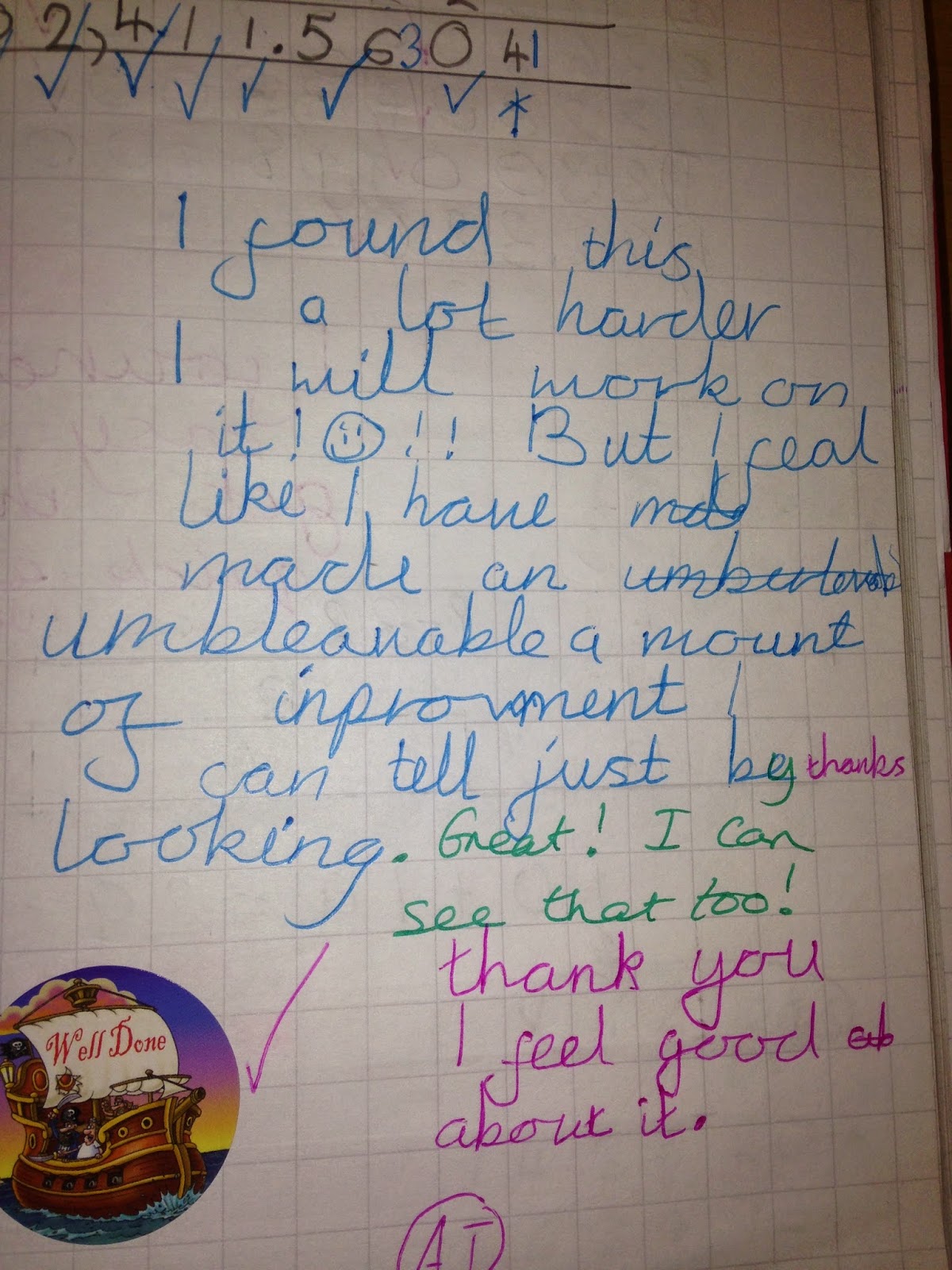
This, in turn, has fed into their own language.  Each lesson, children leave a quick comment about their learning (in gel pen).  Comments like this are not rare:


To encourage a growth mindset, I try and praise children for their attitude and effort, rather than just getting correct answers so you'll see the child above received a house-point simply for being "like Wiz", without necessarily getting lots of questions right. 

Ratty and Wiz are easily accessible in my classroom and children who have showed they are "like Wiz" can sit with him for a lesson.  At primary school, this is such a treat and children's faces light up when they get to have him help them with their work! 

Growth Mindset in Feedback
Learning about the research which has taken place to do with the growth mindset and feedback made me re-consider the comments I leave in children's books.   Carol Dweck encourages teachers to avoid the "clever girl/boy" comments and focus on the skills which children have used and the effort they put in to enable them to learn.  


I had a "Great Learning! Now try this:" stamper made so that children were praised for the progress they had made before being challenged in something new. 


Impact on Attitudes
Obviously, the best thing to do to see the impact this has had would be to talk to my class.  Sadly, you can't do that so instead I'll leave you with some of their post-lesson comments which show their mindsets.  I've never taught a class who enjoy learning so much and so who relish challenging lessons; I'm convinced that's down to the growth mindset elements which have been introduced this year.  


Other Quick Ideas from Twitter
  • Having a Mistake of the Day.
  • Encourage children to add "yet" when they say "I can't do it."
  • Having a crown of mistakes - people who learn from their mistakes can wear it.
  • Enjoying being on the "struggle bus" together.
  • Having display boards which promote a growth mindset.
  • Teaching discrete lessons about the brain and how it works.

Further Information
You can buy the book which started it all off here: Mindset by Carol Dweck.
I'm collecting interesting links, videos and images on my Growth Mindset Pinterest board.
There are many books which can help introduce a Growth Mindset to children in this Amazon wishlist.
The effect of praise on mindset video
Mr Bradley's class talking about mindsets video.
Austin's Butterfly video

Thursday, 22 January 2015

Using Highlighters in Primary

In recent weeks, there have been a couple of blog posts (from Alex and Jon) about the use of highlighters in school.  Reading these made me think about my use of highlighters so I decided to go on a highlighter hunt in books for how both the children and I use them to have an impact on learning.  I was completely surprised by how much they are used in my classroom so here are some examples of what I've found they can help with.

CHILDREN'S USE
Sentence Structure
I have written previously about how I have tried to help children sort out there sentences.  Below, you can see how the child has serious errors in their sentences.  Using the highlighters to indicate a change of sentence makes it very clear.  The pupil can then re-write the work in the correct structure.  For more information about how I tackle ingrained misconceptions about sentences, please click here.


Maths Word Problems
I know often teachers ask children to highlight the information in work problems.  I get children to highlight the question as many times children have done the working out right but have chosen the wrong piece of information for the answer.  This helps them answer the actual question they are being asked.


Thinking Blocks
The children also use highlighters in their workings out.  As a school, we use thinking blocks to help children visualise mathematics.  Sometimes, it is necessary to colour some blocks so using highlighters is much quicker than colouring in or shading.  The child below is finding fractions of a number so she has used highlighter to indicate the amount which showing her understanding of the maths concept.


Here you can see highlighters used in fraction word problems and the calculation of the answers.


Long, Chunking, Bus-Stop, Column Division Method (Or whatever else you want to call it!)
Here, highlighters help the children locate where the answer is in their working-out notes.  


Subordinating Conjunctions
When using subordinating conjunctions at the beginning of sentences, children often forget the comma.  I can't remember whether this highlighting was done by a peer or the children themselves but it has helped to highlight the important parts of the sentence: conjunction at the beginning, comma after the clause and ending punctuation.  This serves two main purposes; it helps the children do corrections if they have missed elements and it highlights the key learning so it's easier for me to mark.  


ADULT'S USE
Stampers
I have a few stampers which give different options - highlighters make it clear which part refers to the work.  Our success criteria is organised into Good/Amazing/Awesome and I have a stamp to indicate that a child needs to remember Capital Letters or Full Stops.  You can see these highlighted below. 


Addressing Misconceptions
For children who can read and understand my comments, highlighters help me in explanations of their misconceptions.  Below, I have written out the calculation and the highlighter has helped me focus her attention on her target.


Pink/Green
Many primary schools use this: Pink = Tickled Pink = Evidence of great work  Green = Growth = Things to improve.  As you can see from the photos below, I use this across their work and on our success criteria which is titled Good / Amazing / Awesome (inspired by Ian).  Sometimes I provide corrections for the green areas but often it is the child's job to correct their work.  A simple pink or green mark near the end is accompanied by a comment to show an overall assessment of their work.